

How to Manage Subsurface Risk on Complex Urban Construction Sites
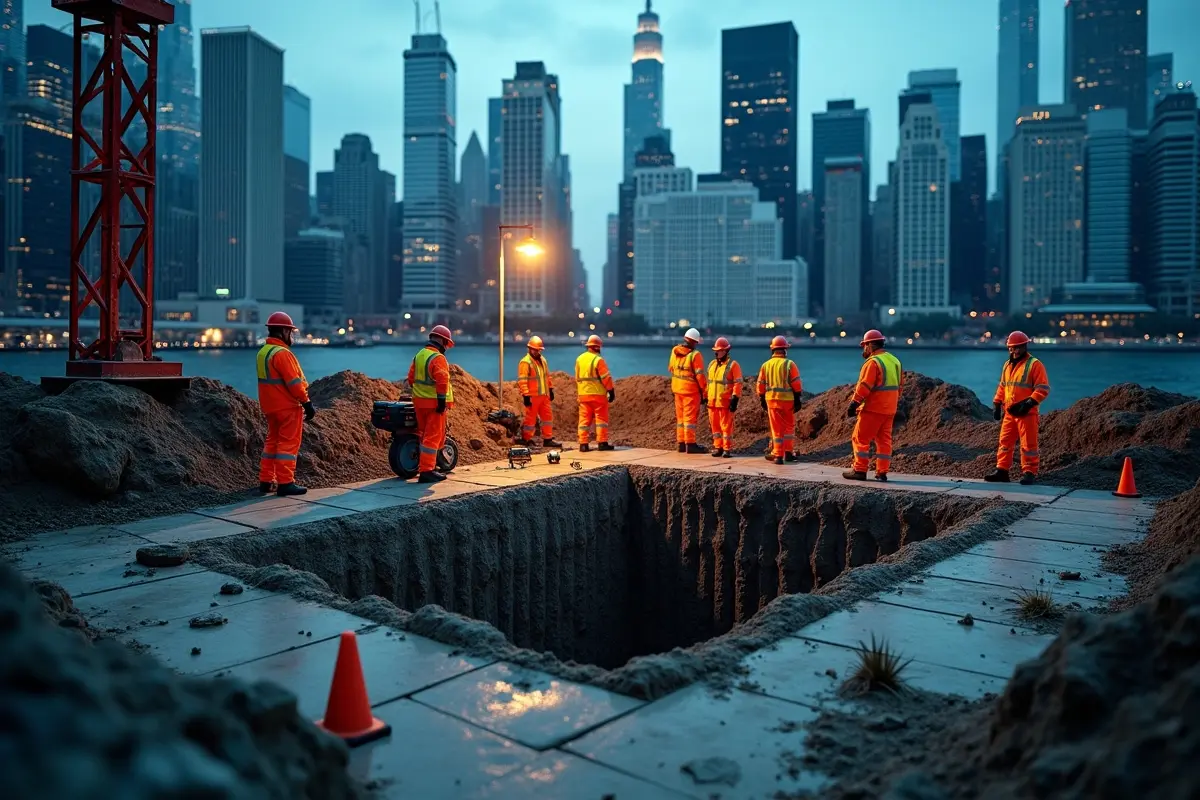
The ground beneath a construction project is a silent partner with whom no one can negotiate. It doesn’t attend progress meetings, doesn’t respond to variation requests, and couldn’t care less about your program. Treat it as a known quantity before excavation begins and you sidestep the single greatest cause of urban construction overruns: discovering what’s underground once you’ve begun to disrupt it.
Why desktop studies aren’t enough
Many projects are still based on a desktop geotechnical study and refer to it as due diligence. This approach is not suitable for any site, and especially not for a site in a dense city where fill history, old foundations, and buried infrastructure are layered amid a century of urban renewal. Due diligence means spending the money to uncover all that, for every site.
That sounds expensive, but the drilling itself is only about two percent of job cost on average. The real cost is holding the shovel while the rig drills, so to speak: stopping, redesigning, and losing days waiting for urgent results. Those costs mount up fast. The basement with the over-designed shoring. The extra elevator because the core wasn’t centered over the shaft. The blasting at midnight because the rock head was unexpected.
It isn’t necessary to take these risks. They can be clearly understood risks, with the application of slightly more money at the right point.
Finding what’s buried before you hit it
The most frequent and most costly subsurface incident on any urban job is hitting a buried utility, and it’s generally avoidable. In Australia, a buried service is hit on average every three minutes somewhere in the country (Dial Before You Dig). That number alone should justify investment in real locating well before an operator throws a bucket into the ground.
A single Dial Before You Dig enquiry will give you an idea of which infrastructure owners have pipes or cables in the vicinity of your job site – but it’s only an idea. DBYD referral maps don’t tell you the exact depth. They don’t tell you the exact alignment. And they don’t tell you if the as-builts are anything like the reality, which often they’re not when you are working on a site that has been redeveloped numerous times in the past.
Ground-penetrating radar scanning is a non-destructive technology that finds the buried services, the old foundations, and the subsurface voids or obstructions that never got marked on the as-built plans. Vacuum excavation test pits – the potholing or soft-dig that uses high-pressure water and a vacuum in place of a sharp metal bucket – will expose what the radar has located without the risk of a machine strike. Experienced teams use all three in concert to build up a picture of the underground infrastructure they can rely on. If you rely on just one of them, you’ll owe an asset owner an explanation of why you severed their gas main.
Reading the ground the way the city built it
Sydney has different geology from block to block, and identifying the right kind of rock and soil you are working with can completely change how your project is going to run. Knowing what kind of rock you’re working on can convert problematic excavations into straightforward ones, or transform water management from the central concern into a non-issue. The faster you get that information, the less risk you start underwriting in guessing.
For a Sydney geotech on civil projects, it’s a massive city of tiny patches and pieces with very different characters. That’s why rock and soil sampling is so important for any Sydney project. Geo-environmental characterisation helps manage risk and construction costs as early as possible by finding out what’s there, and only then factoring in in-depth local knowledge and site-specific conditions.
When project teams are finalising their delivery partners, it’s worth looking specifically at excavation companies in Sydney with that regional ground experience, because by investing in early geo-environmental characterisation, you might relocate an access pit two metres over instead of footings six metres down.
Groundwater is a design problem, not a site problem
Groundwater is behind more excavation collapses than many project teams anticipate, for the simple reason that it’s too often something to concentrate on responsively rather than proactively. Unplanned inflow washes out faces, undercuts cuts, and, most sensitive on constrained urban locations, forces the water table low enough to cause settlement in nearby buildings as they bear down on potentially weakened soil.
Dewatering works best when it’s a design decision, not an adaptation once the job’s on site and knee-deep in water. Choose your approach – well points, sump pumping, cut-off walls, or, as on boring machines, keeping the face pressurised – early. Decide where the wells sit in relation to the dig and to nearby structures. Get your discharge permits before you even mobilize to site. A dewatering schedule that’s tacked on after the first flooded trench almost always costs more and takes longer to get approved than a regime that’s part of your original design agreement.
Monitoring before you cut, not after you crack something
Instrumentation only works if it’s in the ground before excavation starts. The geotechnical spec outlines the locations and depths where you need to monitor settlement, pore pressure, and vibration. And the geotechnical engineer probably picked those locations based on ground conditions and their knowledge of adjacent structures and infrastructure.
The geotechnical spec will also describe the approved installation of the various instruments needed. Settlement markers need to go in undisturbed soil and be regularly checked for plumb with a level over the course of the works. Vibrating-wire piezometers need to be buried in a sand-cement grout to make sure the minor movements of the wire are transmitted to the surrounding soil. Vibration monitors often need to be mounted in a prefabricated vault sunk into the bedrock, ready for the monitor to be dropped in when it’s time to start readings.
Shoring is engineering, not a line item
Every type of deep excavation support system – whether it is sheet piles, soldier piles, strutting, or any suitable combination according to the ground performance – is required to be designed and sealed by a geotechnical engineer, not chosen based on who is cheapest to install. Groundwater pressure must be considered in designing the wall, as well as surcharge loads from site traffic and stockpiles, plus the actual load of the buildings pressing down quite close to the excavation line.
This is also where the quality of the subsurface investigation feeds directly back into cost. A shoring design based on measured borehole data across the site is tighter and cheaper than one based on conservative assumptions covering for unknown ground. Good data upstream pays for itself in the shoring package alone.
Agree the contingency plan before you need it
There is no dig, no matter how thorough the investigation, that can completely eliminate the possibility of coming across unanticipated situations – unexpected rock, a pocket of contaminated soil, a groundwater seam that hadn’t shown up in any of the samples, or a heritage find that stops work under regulation. Urban digs bring this to the surface more frequently than many realize, and a site without a pre-agreed discovery protocol loses days to confusion about who to call and what happens to the program while a decision gets made.
The solution is to pre-build these scenarios into the construction risk register before you ever break ground, complete with likelihood, responsibility, and pre-assigned response actions. When unforeseen ground conditions present themselves during excavation, the question of who now ‘owns’ the problem shouldn’t be up in the air – it should already be answered by the document that everybody locked in at the start. Projects that skip this step tend to resolve the same scenarios through variation claims and contractual disputes instead, which ends up costing more in time and relationships than the contingency planning they tried to avoid.
Get the right people in the room early
Getting specific contractors on board early, and giving time in the budget to incorporate their feedback at the design stage, is well understood in the industry by now. But achieving it is still rare. Time is too tight, the expectation of the magical fix from digital twin or Design for Manufacture and Assembly (DfMA) technology is too high, teams are too siloed and risk-averse.
Early contractor involvement will unlock the cost savings for any intensive and/or complicated excavation. Without it, those cost heads will keep being revisited, and not all of the answers will be one that the client wants to hear.
Keep the regulatory gateways moving
All the technical work stays irrelevant if a missed permit or notification leads to work being halted. Be aware of council development approvals, utility notification needs, acid sulfate soil management plans, and public safety conditions right from the beginning, not identified reactively months into construction. A stop-work order over a missed notification is entirely preventable, and it’s one of the few delays on a construction project that comes with no technical excuse. Develop the regulatory schedule in parallel with the geotechnical and monitoring plans, assign ownership for each gateway, and review it at the same cadence as the risk register.
Subsurface risk management isn’t a single task you hand to the excavation subcontractor and forget about. It’s a sequence – investigate, locate, interpret, design for water, monitor, engineer the support, plan for the unknown, and bring the right people in early enough to act on all of it. Projects that run this sequence properly don’t eliminate surprises underground. They just stop being surprised by them.





0